

Tales From FNR with Professor Emeritus Michael O. Hunt
Dr. Michael O. Hunt came to West Lafayette in February 1960 as an assistant professor and FNR’s first
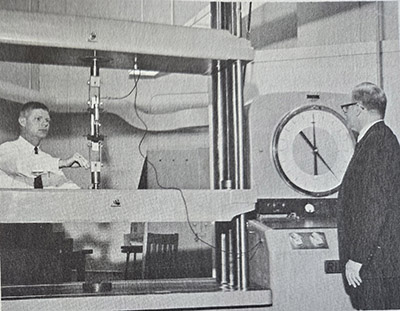
Extension Specialist of Wood Utilization. Although he never thought he would live north of the Ohio River, he would stay at Purdue for 47 years, helping grow the Wood Research Lab before retiring in December 2006.
Prior to joining the FNR faculty, he earned his bachelor’s degree at the University of Kentucky in 1957 and his master’s degree in wood technology from Duke University in 1958. He served in the Army and then took a job with Pointsett Lumber and Manufacturing Company in South Carolina and Arkansas, which operated as the wood products division of Singer Sewing Machine Company. In the product engineering department, Hunt oversaw the manufacture of all sewing machine cabinets and fixtures for Singer and provided the engineering work. Then Purdue came calling.
“Dean (William C.) Bramble wanted to create a new position that was to be the bridge between the campus and consumers of the knowledge that was created on campus, to extend the research,” Hunt recalled. “I was 24 years old with one year of industrial experience and a master’s degree. Then, when I got here, I realized everybody had a PhD. I figured the job market would improve and I would go back and get a job in the furniture industry, but it didn’t happen. So, I decided that if I was going to have a career at Purdue, I had to have the union card, a PhD. But I didn’t want just any old PhD. I wanted a PhD that was strong in wood material science and engineering. Stan Suddarth was a super mentor, he said it is your ball game, do what you need to do, and I did. I subsequently took a sabbatical at North Carolina State University, got my PhD in wood science and was on a career track. I got promoted to full professor and, years later, became the director of the Wood Research Lab when Stan retired.
“I came and never left. There were opportunities to go elsewhere but, at every stage, I decided this was better than what I was being offered elsewhere. It was a good place to work and good science and good engineering work were being done here and I enjoyed it. Nobody had any idea that I would be a university professor, it just happened, but it was a very fun and rewarding career.”
His work at Purdue eventually transitioned from extension work to a predominantly research appointment. He also taught a senior level graduate course, Wood Based Composites. His research funding included a collaborative project with the Forest Products Lab in Madison, Wisconsin, on composites, which eventually led to a patent.
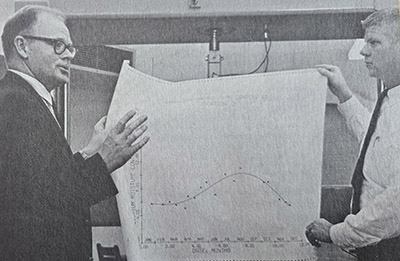
“As a master’s student at Duke, I used a garbage can and a small laboratory hot press to make a composite that became known as flakeboard,” Hunt said. “It seemed that using flakeboard composite for a given application would solve wastefulness. Dr. Bill Hoover and I and Dave Fergus, my first graduate student, did a bang-up job looking at not only the engineering feasibility but also the economic feasibility of making composite products. The product that we designed is the one we got the patent on. Mason Carter prodded me on it and said why don’t you try it, and it worked. I was self-taught. A lot of faculty members get an idea and they have to prove or disprove it, so they are very creative. Purdue had an excellent and engaged faculty.”
The Wood Research Lab was thriving and multi-dimensional. Suddarth was working on roof trusses. Dr. John Senft’s specialty was machine stress-rated lumber, Dr. Carl Eckelman specialized in furniture engineering and Hunt added the composite work. Dr. Dan Cassens was eventually hired to take over the extension work from Hunt and teach courses, allowing Hunt more time for research.
“The most fun thing about being on the faculty was the graduate students and student research assistants that I had,” Hunt shared.
- PhD students: Dave Fergus, Michael Triche, Jim Bradtmueller, Zhiyong Cai
- Master’s students: Bob Lattanzi, Jim Bateman, Dave Horn, Greg Dunsworth
- Research assistant extraordinaire: Linda Kirk Brown
“I had a great time with my students, but first was their grades and their research, and they published their
research. They didn’t have any experience as far as research, so we showed them, we worked together and they learned how to write. I had an objective; I wanted to solve this particular problem and the graduate student got me from A to B. They were the ones taking the courses and so forth that needed to be applied to solve the problem, so that was the plan of study. The professor had the idea but the graduate student had to prove or disprove whether the idea was worthwhile.”
Brown, who is now an engineer at Southern Pine Inspection Bureau in Pensacola, Florida, worked with Hunt as an undergraduate student research assistant from 1984-86, testing materials for Mike Triche’s doctoral work and Greg Dunsmore’s master’s work, among other things.
“Dr. Hunt was a passionate and knowledgeable professor with high expectations of his students,” said Brown, who earned her bachelor’s in agricultural engineering in 1986. “He taught us the history and current state of wood-based composites at the time. He was entertaining to listen to with many personal stories about his first-hand relationships with important people in the industry. He was a great mentor and sounding board as I fine-tuned my major (I ultimately graduated from the Ag Engineering Department honors program, where I created my own plan of study to focus on the engineering uses of wood.) The knowledge I gained from Dr. Hunt prepared me to continue my education with a master’s degree and was part of my unique qualifications for my job as an engineer for the Southern Pine Inspection Bureau.
“He was great to work for. The graduate students and undergrad research assistants had a great camaraderie with each other and the professors in the Wood Lab. He hosted gatherings for us to watch his beloved Kentucky Wildcats play opponents near and dear to his grad students, like LSU. My parents lived in West Lafayette for years after I graduated, so I often returned to West Lafayette and would usually end up going to lunch with Dr. Hunt and his wife or just stopping by their house to visit and catch up. We would spend hours catching up personally, as well as keeping each other informed about our respective areas of work in the wood industry. It was always a joy to reconnect with Dr. Hunt. I was especially honored to be part of the planning committee and help bring his vision for the reunion to life.”
One of those students with whom Hunt had a friendly rivalry was Michael Triche, who was from Baton Rouge, Louisiana.
“Both LSU and Kentucky are in the Southeastern Conference and basketball is a big deal, so he and I would carry on about who was best,” Hunt recalled. “On one particular occasion, Mike got all of the graduate students T-shirts in purple and gold, LSU’s colors, and it was so much fun. Michael was Cajun through and through. He made jambalaya, we had some beer and just had a heck of a fun time. I don’t remember who won and he probably doesn’t either.”
Triche had high praise for Hunt’s impact, but also managed to drop a friendly barb in about their rivalry when discussing his friend and mentor.
“Other than being a UK ‘Mildcat’ basketball fan, Dr. Hunt has my highest respect and gratitude for his commitment to excellence and his friendship,” Triche (MS 1984, PhD 1988) said. “Dr. Hunt was a leader in his field of wood composites and was instrumental in helping Purdue become a National Science Foundation Center for wood research. The center was a part of a large multidisciplinary research effort that funded numerous graduate students in the department of forestry. The Wood Research Lab under Dr. Hunt’s direction was booming and had an international presence in the wood research arena. It was an honor to be part of this effort.”
Dr. Jim Bradtmueller (MS 1987 under Dr. Carl Eckelman, PhD 1992 under Hunt), worked in the Wood Research Lab as an undergraduate student in agricultural engineering and went on to a career in the engineered lumber and structural composite lumber industry for Trus Joist MacMillan and Weyerhaeuser and later joined the faculty in the department of construction management at Northern Kentucky University until his retirement.
“I really enjoyed all aspects of the Wood Lab’s research and the people that worked there and became interested in getting to learn more via graduate school,” Bradtmueller said. “Being at Purdue allowed me to take most of my graduate-level courses in engineering and statistics and apply those back to the research being conducted in the Wood Lab. I had the opportunity to work for or learn from all the professors who were there at the time and felt fortunate to be in the Wood Lab during a period when very active and highly diverse research was being conducted. Graduate students and visiting scientists were there from all over the U.S. and other countries and we all collaborated well together. I am very grateful to professors Hunt, Eckelman, Cassens, Senft and Suddarth for their investment in me and countless others over the many decades that their careers spanned.”
Dave Fergus, who earned his master’s degree in 1976 and PhD in 1979, first met Hunt as a summer intern in the Wood Lab. After working as a half-time graduate assistant under Dr. John Senft while completing his master’s degree. Fergus worked full time as a research assistant on a USDA Forest Service Project with Hunt while completing his PhD. Fergus also met his wife, Patricia “Pattie” Kearney, in the wood lab.
“Two great things Mike espoused stayed with me throughout my career: 1) get everyone involved and 2) broaden your horizons,” Fergus said. “Titles and positions don’t matter much. You never have enough resources on projects or in business, so the best teams get the most out of all members. The no weak link theory was in Mike’s bag of tricks. We were encouraged to take courses outside our immediate area of study. We also attended meetings and conferences, establishing a network of contacts through the forest products industry. Throughout my career, if I mentioned I was a student of Mike’s, I gained instant credibility. But Mike’s influence and leadership went far beyond the world of the Wood Research Lab. We played racquetball at the co-rec. Mike joined Pattie’s family softball team in the Lafayette city summer league. And it was not uncommon to find many of us sharing fun stories about our adventures and experiences in the back room at Bruno’s on a Friday evening.”
Zhiyong Cai, who joined the Wood Research Lab in 1993 to work on his PhD under Dr. Hunt, said his experiences stayed with him well beyond the classroom or lab.
“I was his last student and working on my dissertation on the duration of load (DOL) effect of wood,” said Cai, who is now a project leader and materials research engineer in the Engineered Composites Science unit for the USDA Forest Service. “Dr. Hunt was not only my major professor but was my career mentor as well. I learned a lot from him. His successful experiences in teaching and research provided me with a wonderful model to follow. My PhD study and postdoc working experience with Dr. Hunt at Purdue ensured my rewarding career as a product engineer for a company, assistant professor at a university and research scientist at the Forest Products Lab.”
Another student, Mike Gilley, remembers not only the great work environment and the knowledge gained, but also forming bonds outside of the lab.
“I was lucky to get a part-time job in the Wood Research Lab and a whole new door opened for me,” said Gilley, who is now the owner of GHK Truss. “Along with meeting and working with my good friend Linda Kirk (Brown), I met professor Hunt, who was fun to be around and also so impressive with his knowledge and intellectual curiosity. This grew to meeting the other professors and graduate students who worked in and around the Wood Research Lab. What a great bunch of people. We enjoyed many social gatherings outside of the Wood Lab, including camping at Shades State Park, tubing down Sugar Creek, a cookout at Dan Cassens’ property and many others.”
It was those many experiences and the faces behind them that brought Hunt comfort and came to mind when he was in the hospital in 2021.
“As I was laying in the hospital bed with nothing to do other than look at the wall or the ceiling, I realized my
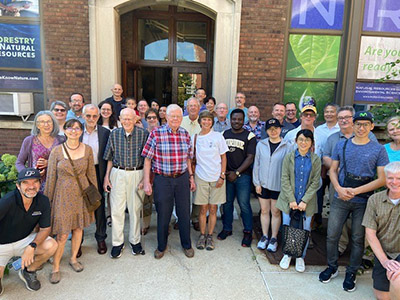
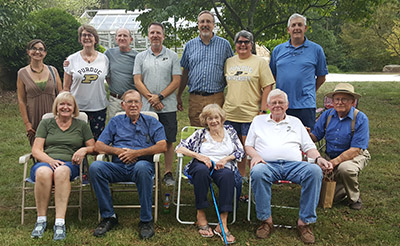
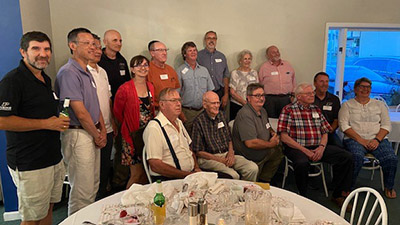
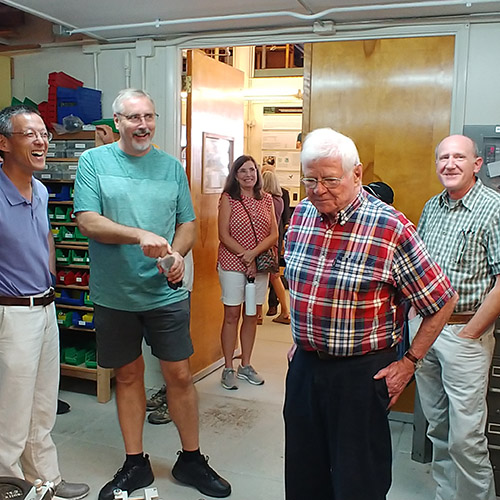
legacy is the graduate students. I got to thinking about my career and remembering the graduate students that were involved and how fun it was,” Hunt shared. “So, I had an idea for a reunion. Jim Bradtmueller and Linda Brown volunteered to organize it along with Eva Haviarova of the Purdue Wood Lab. The first reunion date was Sept. 18, 2021, but the Delta variant of COVID surged and the decision was made to cancel with hopes of rescheduling. However, so much energy had been put into the planning, the committee went ahead with a mini reunion on the planned date, outdoors at the Wright Center. The big reunion was rescheduled for the following year on Aug. 27, 2022.
“Sixty people came. All three of my children attended one or both of the reunions – one from Greensboro, North Carolina; one from Burlington, Vermont; and one from Milwaukee, Wisconsin. All three of them came because they wanted to see my graduate students, who were close friends. It was really neat. They were just chattering up a storm about I’m doing this and how have you been all these years, etc. I had a ball watching them just talking, giggling and all grown up now. It was a really nice experience and one of the last things that my late wife really appreciated. (Phyllis passed away in September 2022.)”
While the reunion allowed Hunt to reminisce about the old days and his time with students, he is constantly surrounded by a passion project that began as research on old buildings while he was still at Purdue.
“Before retirement, the last projects I had were spawned by old buildings downtown,” Hunt said. “I was interested in preserving and keeping the old brick two and three-story buildings with painted wood facades along Main Streets in the Midwestern USA from being torn down. I worked closely with Robert Leavitt, Wood Lab Manager, on these projects. The first research focused on the weathering of painted wood construction. The second, in cooperation with the engineering staff at the Forest Products Lab in Madison, involved non-destructive testing. We developed a vibration-based analysis for predicting the strength of floor systems in these old buildings. You didn’t have to tear old buildings down because you didn’t know if the floors were strong enough to support an application like a boutique or restaurant, etc. We engineered them. That was a neat project. It was a nice one to end up on.”
That work also led to the preservation of Pfendler Hall, formerly known as Entomology Hall. Hunt, then the chairman of the campus preservation committee of The Wabash Valley Trust for Historic Preservation, told university administration that the building, then the second-oldest on campus, should not be torn down and successfully fought to save it.
Hunt, who served as president of the Forest Products Society for 1990-91, retired just after Christmas in 2006, but beyond his research, Hunt has maintained a vested interest in wood and the preservation and restoration of old homes. It all began after he and his wife Phyllis, formerly an administrative assistant in the department of sociology, were married in 1993 and bought and restored a Greek Revival-style home in downtown Lafayette.
“When Phyllis and I came down here, we looked around and said gee whiz, we don’t have any neighbors,” Hunt noted. “There wasn’t anything here, just grass or weed-filled lots. None of the row homes to the north of us or town homes opposite us or on the next block down were here. It was all created by virtue of us living and working with other people, like our good friends across the street, the Dixons. We are a group of neighbors who invest their own money to upgrade the properties around us to make it a destination. Phyllis became the president of the Centennial Neighborhood Association. We rebuilt and recreated a neighborhood with nice places to live in a historic neighborhood, to such an extent that the city uses it as a model for how things should be done in older neighborhoods to use historic restoration to recreate livable dwellings.”
The neighborhood group, the Centennial Neighbors Investment Group LLC, has purchased three sets of renovated properties in downtown Lafayette since 2010. In his blog, Based in Lafayette, Dave Bangert documented the group’s success in a Dec. 2022 story ‘Centennial Neighborhood’s Big Bet on Itself.’
“Michael Hunt, relentless advocate of one of Lafayette’s oldest neighborhoods checked in. The news: The Centennial Neighbors Investment Group had closed the deal on another set of renovated properties, the third time a collection of neighbors had bet and won on the blocks just north of downtown Lafayette in the past decade or so, without a promise of a return beyond making Centennial a better place.”
The initial investment in 2010 worked to convert a vacant industrial property on N. 5th Street across from Hunt’s home into owner-occupied townhomes that would match the architecture of the neighborhood, which was founded as the Bartholomew and Davis Addition in 1829.
“I knew if we didn’t bet on our ourselves, we couldn’t expect anyone else to,” Hunt said at the time.
Professor emeritus Bill Hoover summed up Hunt’s personality and impact by tying it all back to his southern roots.
“Mike’s the epitome of a southern gentleman, reflected in his gestures, manner of speaking, appearance, dress, et al.,” Hoover shared. “His Kentucky roots must be reflected in his genetics. It’s also most likely the basis for his commitment to historical preservation in general, but buildings in particular. He gets credit, along with the Wright Fund, for the restoration of Pfendler Hall, now home of the Department of Forestry and Natural Resources. He also gets credit for the renewal of Lafayette’s Centennial Neighborhood. His wife Phyllis was a full partner in this work. Although Mike has had personal challenges in recent years, he has weathered them all in a manner to be emulated, or as expected of a southern gentleman.”
More than 65 years later, Hunt is still making an impact in the community that snatched him from industry and the South and became his home.
In 2025, he established the Michael O. Hunt Endowment in Wood Products, which created a graduate student support fund to assist in the advancement of wood products research. Donate to the endowment through the Purdue FNR giving website.
Featured Stories
Carolyn Foley, a long-time member of the Purdue Forestry and Natural Resources (FNR) and...
Purdue University’s College of Agriculture recognized nine alumni at the Distinguished...
Keep your eyes peeled across Indiana for the newly minted Purdue Forestry and Natural Resources...
Senior wildlife major Madison Medley spent her summer as a natural resource intern with Hamilton...
Addy Ellis, a sophomore aquatic sciences and political science double major, spent the summer as...
Zachary Feiner, who earned his PhD from FNR in 2015 and spent two additional years in West...