

FNR Field Report: Brett Cox Recaps Week 2 of Sweden Study Abroad Trip
Throughout the 2026 Sustainable Natural Resources study abroad course in Sweden and Norway, FNR students will check in to provide weekly updates on the trip's highlights.
Brett Cox, a sophomore forestry major, is involved with the Society of American Foresters as the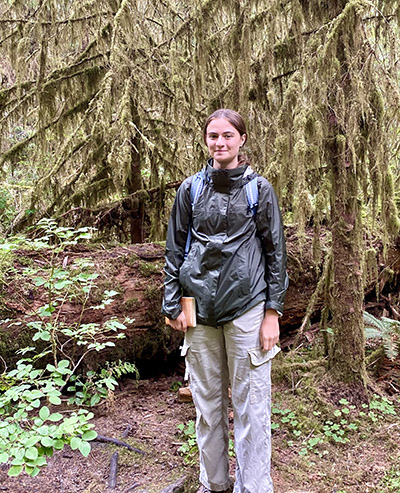 secretary. She also is a member of the Student Chapter of Environmental Education (SCEE) and is a Forestry and Natural Resources Ambassador. In addition to the Sustainable Natural Resources study abroad trip, the Fort Wayne, Indiana, native will spend her summer volunteering for a local land trust.
During the three-week Sustainable Natural Resources study abroad course students will examine natural resources broadly defined, including forestry, fisheries, wildlife, agriculture, mining, outdoor recreation, and urban sustainability. They will define, discover, and document examples where sustainability of resource use matters. The course explores the effect of terrain, climate, vegetation, faunal assemblages, social structures and technologies on natural resource use. FNR 46000 is a collaboration of Purdue University, North Carolina State University, and the Swedish University of Agricultural Sciences. American and Swedish students work together to research issues in resource management.
The course is co-taught by FNR's Drs. Tomas Hook and Doug Jacobs as well as other instructors from NC State and SLU.
Brett Cox provides her recap of Week 2 of the trip below.
Monday, June 29
Travel day! This morning we left Abisko via bus to Tromso. Part of living in the cabins in Abisko was cleaning them completely before we left, so my cabinmates and I got up early to clean the kitchen and bathroom and mop the floors. After cleaning we got on a bus to Tromso. The bus ride was very scenic as we entered Norway, and I hardly looked away from the window the whole time. Our drive was alongside large mountains, and, as we traveled, we made our way into large fjords. I spotted quite a few waterfalls and it seemed like the mountains only got larger as we traveled. We arrived and once again we stayed in cabins, however these cabins were directly facing the creek. From my window you could see the clear water and hear the creek, which was incredibly peaceful. We headed into the neighborhood for groceries, and right away I noticed all of the posters, products and other things decorated specifically for the World Cup! Even my smoothie featured one of Norway’s top soccer players. When I got back from the grocery store, I settled down for the night and went to bed early after a long travel day.
Our first day in Tromso started off at the Institute of Marine Research. We took the bus and I got my first look at the main downtown of Tromso. The town was busy and lively, and many people were out eating, shopping and headed to work. We met with Dr. Per Arneberg and he gave a presentation on many of the methods of research the institution uses to make sure their data reports accurately represent what can be found in the local marine environment. He explained that marine models on climate change are often tricky to make and use because the climate has such a large ripple effect that can be hard to follow. However, the institute has worked to develop a system to filter and check their data. By using a rating system of both the amount of evidence and the significance of the differences found, they are able to make more accurate claims. He mentioned that one big takeaway we should consider in our work is that putting effort into data clarity can help prevent public confusion on climate issues. After the presentation, we went to the hot dog stand, which was a tiny little stand in the center of Tromso that sells hotdogs and some drinks, with their specialty being a reindeer hotdog. I had to try the reindeer hotdog, and, outside of the look of it, the taste was so similar to a regular hot dog that I almost forgot it was reindeer.
Museum tour day! Today we started off at the Arctic Museum of Norway, which included a wide range of topics. I started upstairs, which was an exhibit dedicated to telling the modern history of the Sami people. Although much of the exhibit was in Norwegian, the exhibit told a lot through images alone. The other exhibits had English translations, or they had packets in the doorway with many different languages to pick from the text inside each hall. Downstairs, the exhibits were dedicated to the scientific history of the area and the different geological and biological features of the arctic region. The next museum was in an old boathouse. The museum had a wide range of old tools, weapons, books, photos and other artifacts from the arctic hunters and explorers of the past. One room was entirely dedicated to showcasing the different types of seals and the different methods used to hunt and use their fur. For me, the most interesting artifacts of the museum were the old letters that the boatmen had sent back home to their loved ones. Each letter recalled a different small piece into the day to day lives they lived and the larger issues they had to face. Learning about all the attempts, success and failures the explorers had trying to explore the North Pole and the arctic region as a whole gave me a lot of insight into just how severe the wintertime here is and was. After the museum I went to a store in town to buy yarn for a sweater I plan to crochet and some gifts for my mom and friends back home. We went to 7-11, which was nothing like convenience stores in the U.S. I got a puff pastry filled with spinach and topped with cheese, which was extremely good!
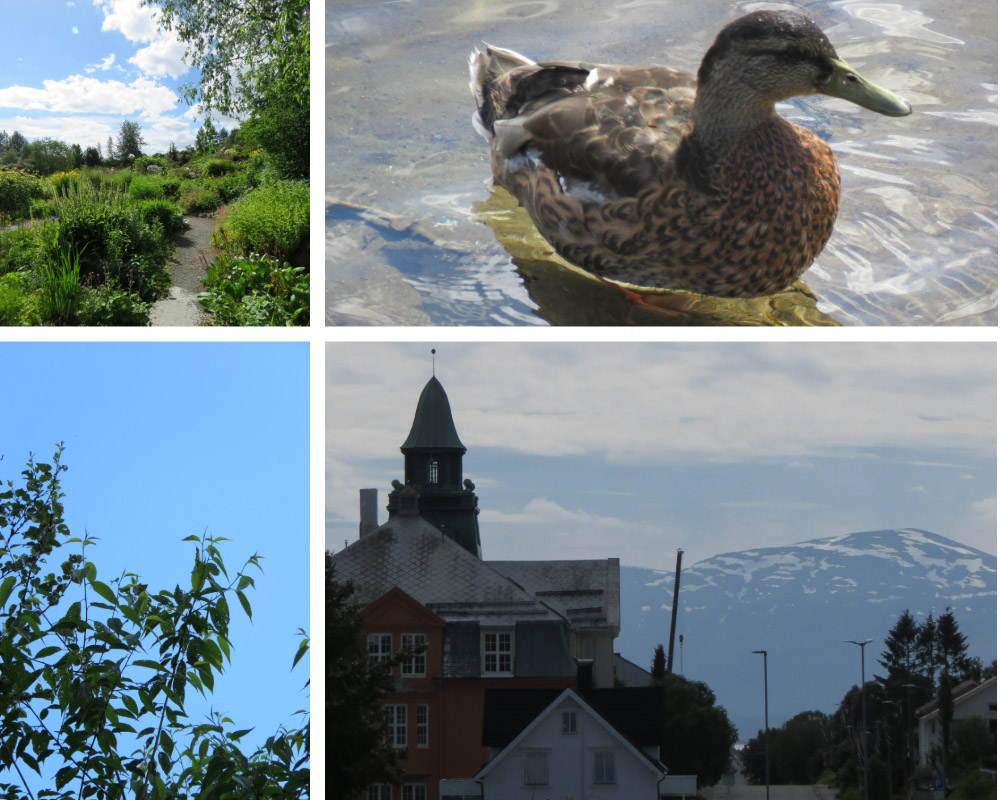
Today we went to Polaria, an aquarium that has a focus on research and public education on the arctic. We took a tour of the aquarium and learned about the speed that climate change is affecting the arctic and the clear indications that can be seen in the arctic environment. We got to see arctic fish, such as cod and haddock, and even seals. The seals at Polaria are trained for their health rather than for entertainment, but also serve as a way to expose the public to the concepts of arctic environments. After exploring the aquarium, we headed to the botanical gardens of Tromso. The gardens were beautiful and were sorted to mimic the different landscapes found in nature. I took the time to learn a few of the tree species and to practice my tree ID in a completely new environment! After the gardens, we headed to “the most northern” McDonalds. One funny thing about Tromso is that everything here has the title of “the northern most” in front of it. Although it is likely true, it's funny how often things have this title. The menu was slightly different than in the US, and Sage got spicy chicken nuggets, a menu item that none of us had ever seen before. On the way back we did some bird watching and I took photos of a duck outside of the bus stop in the river. Before bed, we played many rounds of cards in the cabin.
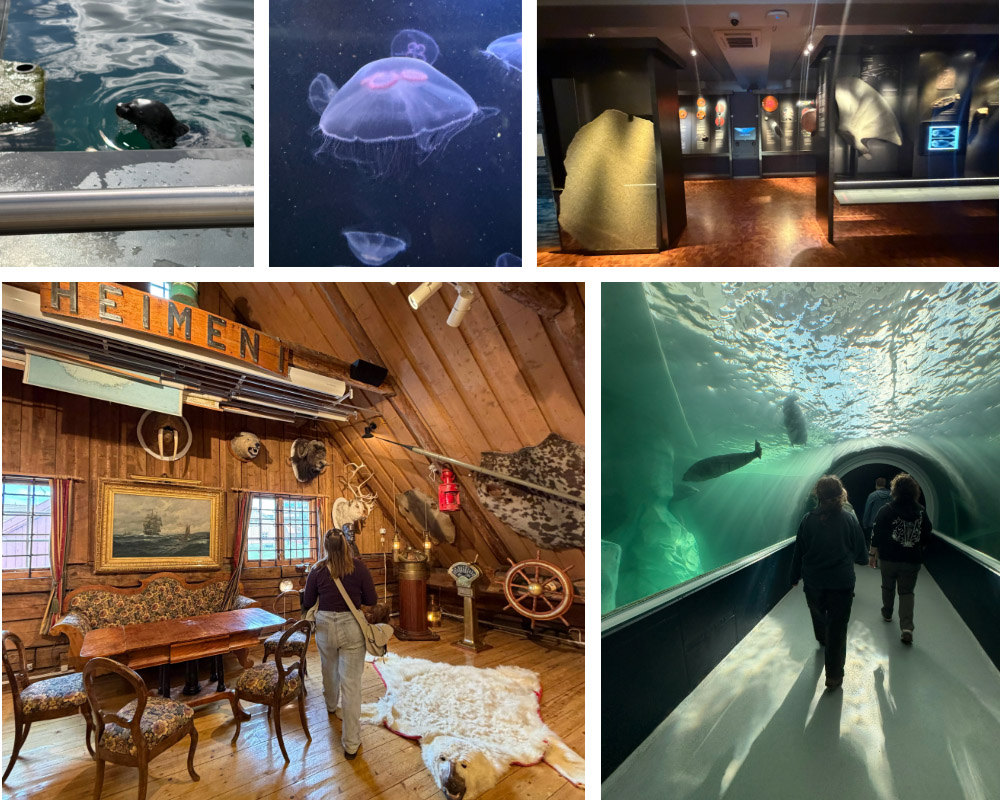
Friday was a free day, and many of us decided to go to the beach. We took the bus and then walked to a big park along the coast. The beach had many people around and we got to look for fish, crabs and interesting rocks. I searched in the sand for a while and found lots of sea glass, shells and quartz. Out in the shallow water, Sam found a dead crab and jellyfish that had both washed up. Because of the weather, many sailboats were out on the water. The water was cold, so only a few of us waded and not for very long. I ran to the nearby store for lunch and got a sandwich and a bag of candy. In both Sweden and Norway you can find a large wall of candy in almost any grocery store. You get a paper bag, and you can scoop whatever candy you want into your bag and pay based on the weight. I got many kinds of candy that we all passed around and tried, with some more well liked than others. The licorice balls I got were super salty, but luckily the caramel covered licorice was much better. Licorice is everywhere here, and I have been getting it any chance I get. It was the perfect day for the beach, reaching a high of 62 degrees. That might not sound too tropical, but for the arctic circle it was warm! On the way back from the beach Katharine spotted one of the largest Lilac bushes I have ever seen, it was the size of a full tree!
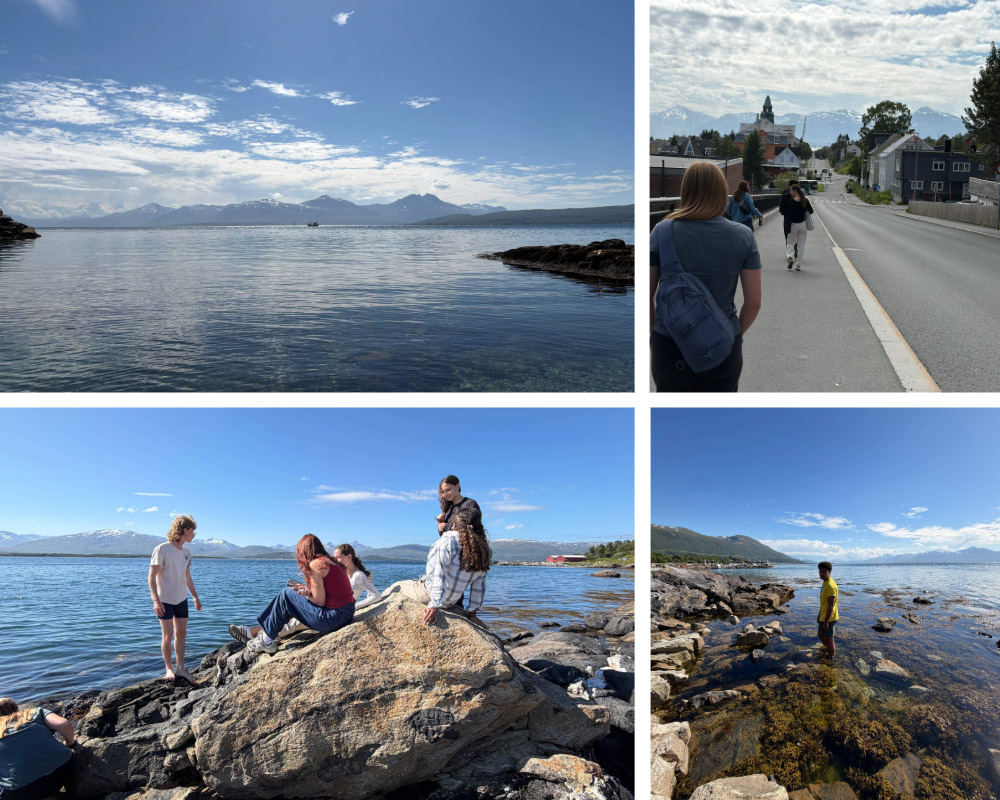
Saturday, July 4
Saturday morning we had more free time, and I decided to check out a cafe in town. The cafe was interesting because it was pretty much self service. You start off at a coffee machine, but the machine can make a variety of coffee drinks. I simply pressed a button and I had a latte! Then you get a tray and select from a large wall of pastries, and pay at the counter at the end. Alison and I ended up both getting a pain au chocolate without even looking at each other’s choices! We spent the rest of the morning looking for a market that we realized later had been canceled, however we both enjoyed our time spent because we got to see the whole town and look at some of the historical buildings. We met up with Katharine and did some shopping around town. I got more yarn, and another pastry for lunch.
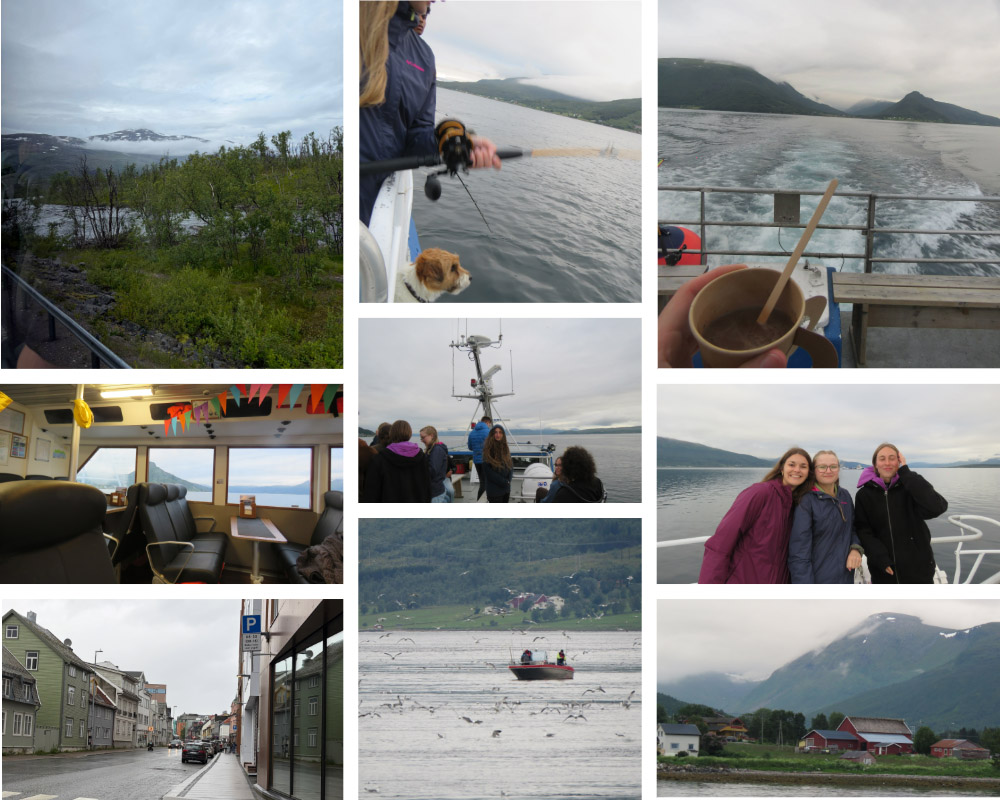
In the evening we met back up as a full group to go on a boat tour of the fjords of the surrounding area.
When we made it to the boat, we were immediately greeted not just by the boat staff, but by two little dogs that lived on the boat and would be headed out with us. We got to see the midnight sun, learn about the area and even try to catch some fish. Many of those who fished caught fish and one woman caught a sea cucumber! The dogs are so adjusted to the boat life that they get very excited when people fish and like to watch and wait for them to pull up something. I got some good photos of the water, and we spotted many kinds of birds. Unfortunately, only two of us spotted puffins and they were flying very far from the boat. The woman that ran the cabin of the boat was so welcoming and she told us many folklore stories on how the area developed. After the boat ride, we all headed back and straight to bed to get rest for the travel day tomorrow.
Sunday, July 5
Today was our biggest day of travel on the trip, and we had to get going fairly early. We left at 7:15 onto a bus that was to take us back to Kiruna, where we were going to catch a train that would then take us down to Umea. Most of us slept on the bus for the first few hours until we stopped at a gas station for a break. We all stretched out our legs and walked around for a while, and we stopped next to a large lake with mountains which was beautiful to enjoy for that short time.
Once we got to Kiruna, we had nearly three hours before the train arrived. A few others and I played cards for that time. We played old maid for a while and then transitioned into spoons, but with pencils. It was a lot of fun and the time went by much quicker! When the train came we took a break from cards for a little bit to rest, and then Sam taught us a brand new game which kept us busy far into the afternoon! At some point around 7 p.m., we switched trains. We had to wait for a little while due to the second train being delayed, but when we got on it was very empty and we got the whole car to ourselves. I then played euchre with Lauren, Katharine, and Nathan until we arrived in Umea. Since the students from N.C. State had already been in Umea during their first week, they were able to guide us around town and to our hostel. Right away we noticed that Umea had many large city trees and clearly put a lot of effort into managing their allées. Most of them were lined with tall, draping branches of birch trees, and they made the whole city feel welcoming right from the start. At this point it was very late, and, once we found our rooms, we went right to bed.
Featured Stories
Maksym Chepeliev, a leading international scholar recognized prominently for his work in...
In recent years attendees at Purdue Agriculture alumni, donor, and faculty and staff events have...
People think grass is simple. Lawns, right? Mow regularly and add some water and fertilizer. What...
The Office of Indiana State Chemist (OISC) is warning Indiana residents about an illegal...
A prominent protein on most human cells may be key to unlocking the code that makes humans...
Ava Hoskins, a double major in aquatic sciences (fisheries concentration) and natural resources...