

Meet Geriann Albers: 2025 Chase S. Osborn Early Career Award Recipient
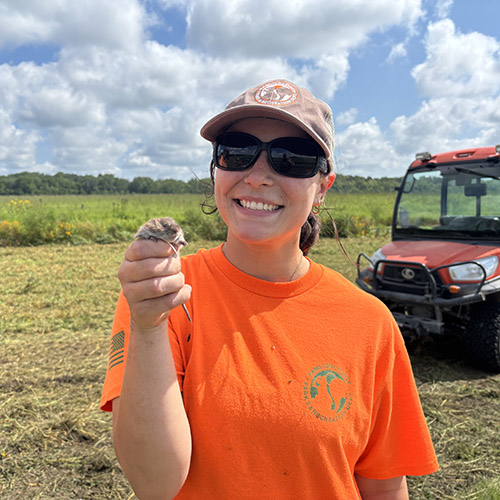
Geriann Albers, furbearer and turkey program leader for the Indiana Department of Natural Resources (DNR), has collaborated with Purdue researchers on various projects since taking her role in 2017. However, when long-time collaborator Dr. Pat Zollner told her she had been selected for the 2025 Chase S. Osborn Early Career Award for Wildlife Conservation, which recognizes significant contributions to wildlife conservation in Indiana through research, teaching, writing or other personal accomplishments, Albers was caught off guard.
“I knew these awards existed as a couple of my colleagues had received them, like Zack Delisle (2024) and Emily McCallen (2023), but I thought they were only for Purdue alums,” Albers said. “My gut reaction was to ask ‘You know I didn’t go to Purdue. I’m not an alumni.’ I was grateful and surprised and really honored, but I wanted to make sure there wasn’t an oversight and someone didn’t think I went to Purdue.
“This award means a lot to me. I’m not a Purdue grad, but I feel like I’ve adopted Purdue University and it means a lot to be recognized by this wonderful university I’ve come to care about and work closely with.”
Albers earned her bachelor’s degree in natural resources and environmental science from the University of Illinois and went on to receive her master’s in wildlife and fisheries resources at West Virginia University. Before joining the Indiana DNR in 2017, the Germantown, Illinois, native worked as an assistant furbearer ecologist and trapper education coordinator for the Wisconsin DNR and the assistant furbearer and black bear biologist with the North Carolina Wildlife Resources Commission.
Over the past nine years, Albers has helped manage Indiana’s furbearers and wild turkey by conducting surveys and research, developing data collection and outreach materials, and drafting and reviewing regulations. Specifically, she has advanced research on species like bobcat and fox and contributed to Indiana’s Technical Advisory Committee for mammals. She also has mentored several Purdue undergraduate and graduate student projects on species ranging from gray fox to river otters and fishers. Albers has served as a board member for the Indiana chapter of The Wildlife Society and is currently the chair of the editorial advisory board for The Wildlife Professional magazine. Previously, she has been honored for her work by the Wisconsin Trappers Association, West Virginia Trappers Association and North Carolina Trappers Association.
How It Began
Although Albers grew up in a small town in Illinois and had uncles who were farmers, she didn’t grow up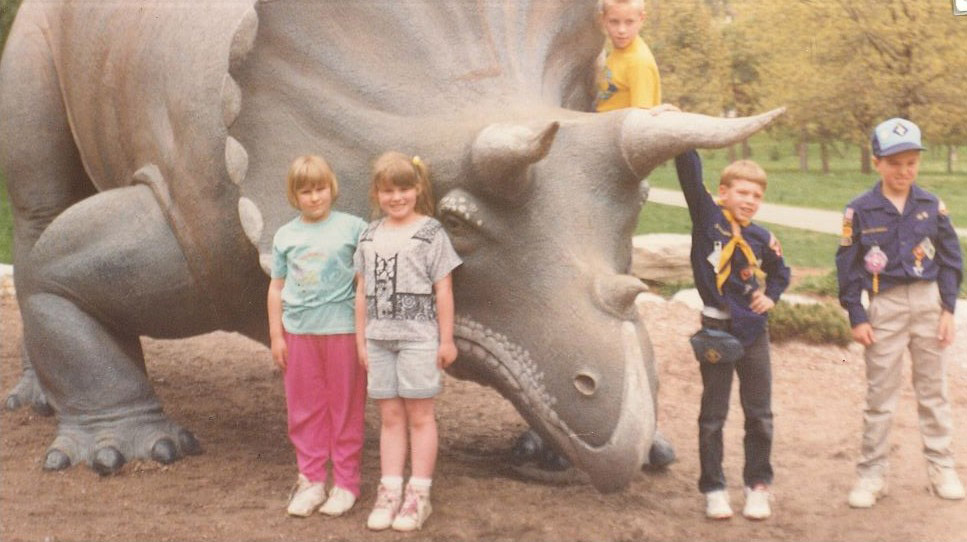 spending time in the woods, camping, hunting or fishing. Instead, she simply loved animals.
“We always had pets,” Albers noted. “I was always the one on car rides pointing out every animal on the side of the road as we drove by. I’ve always been really interested in animals, solving problems and finding solutions for things. I’ve always had a thirst for knowledge.
“I was in 4-H and FFA, so I thought I would go into something in agriculture like animal science. But when I applied to the University of Illinois, they sent me a brochure about all of the cool options in the College of Agriculture. When I got to the page about natural resources and environmental sciences and one of the focuses was fish and wildlife, I was like ‘That’s it. That’s what I want to do.’ And I did. I don’t really know why, but I just knew that was it.”
Although Albers loves her job and the species she works with – especially medium-sized carnivores, she says her motivation extends beyond working with animals.
“I’m honestly more of an indoor kid,” Albers explained. “I just wanted to work to support wildlife and animals and solve problems related to animals. The reason I love my job is that I like learning new things all the time and being able to try to solve problems and make things better. Doing that in the context of animals is why I think I started down this career trajectory.”
Albers’ professors told her to get summer jobs to gain experience in addition to her classwork and she jumped right in. The summer after her first year of college, Albers worked at Eldon Hazlet State Park, cutting grass, emptying trash and interacting with park visitors. The following summer, she joined an otter project in Missouri, which offered her “first taste of field work,” allowing her to learn what field research entailed and what data collection looked like.
A study abroad trip internship to Germany through Hohenheim Universität and Technisches Universität München her junior year brought even more opportunities for hands-on experience.
“In a lot of study abroad programs, you take classes, but they actually set mine up so I could go out with a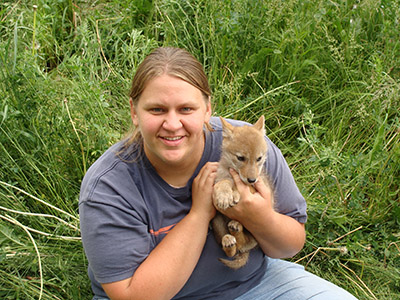 few researchers in Germany,” Albers recalled. “I spent some time helping them collect ticks and also doing some echinococcus baiting work with red foxes and things like that. Then, I shadowed a student for about a month who was doing red fox collaring work in the south of Germany around the Ammersee area. That study abroad experience was really cool, because I got to see a different perspective, being in a different country and seeing what their priorities were and how they did their research.”
Several professors also helped her envision a career in wildlife research. As an undergraduate, Albers collected samples from trapper-caught coyotes and foxes to investigate West Nile virus, which was then emerging as a concern for wildlife. She completed a small undergraduate thesis with Nohra Mateus-Pinilla at the Illinois Natural History Survey and presented a poster on the research as a senior.
Professors Ed Heske and Jeff Brawn, who taught wildlife management courses, also influenced her development.
“I knew the research they were doing and I worked field tech jobs to see what was out there. My undergrad career was all about gaining experience and learning and being active in The Wildlife Society.”
While she expected to pursue an advanced degree, Albers’ early ambitions included studying ocelots for a master's degree, researching caracals in Africa for a PhD and eventually becoming a professor. A few years in the workforce helped her refine those goals and gain additional experience before graduate school.
After graduation, she worked on a Northern Cardinal project for the Illinois Natural History Survey’s Center for Wildlife and Plant Ecology, followed by a wildlife technician position at the University of California at Davis involving radio telemetry and American badgers. An internship with birds and reptiles at Caldwell Zoo in Tyler, Texas, offered her a look at the zoo side of wildlife, which was “not the right fit.”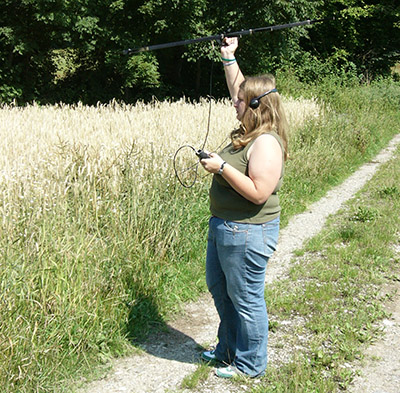
At Cornell University, Albers spent a year and a half as a wildlife technician tracking urban coyotes in New York using very high frequency (VHF) and GPS telemetry.
“I always knew that carnivores were my jam, but I definitely think that is when I really fell in love with coyotes, working with these animals at the urban intersection with people and trying to understand those dynamics,” Albers said.
The following spring, Geriann returned to Missouri to work on an otter project with the Missouri Department of Conservation. A summer on the Urban Coyote Project for the Max McGraw Wildlife Foundation set up Albers for her master’s program at West Virginia University, where she studied coyote diets.
Through her studies, Albers met Rich Rogers, the West Virginia’s furbearer biologist, who woul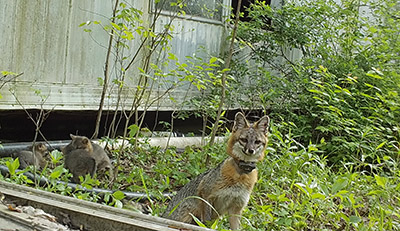 d become an important mentor.
“I had narrowed myself into surveys and research around the furbearer group, but Rich made me realize what job I wanted to do,” she noted. “I knew that I wanted to work with that suite of animals, but I don’t think I realized that furbearer specialist was a job. I knew state agencies had biologists, but I didn’t know there were species specialists until I got to know Rich. He was on my advisory committee and I would see him at fur sales or tagging otter pelts and things like that. Basically, I wanted to be what he was.”
Geriann completed her master’s degree in 2012 after three “very smelly” years processing 1,000 scat and stomach samples from coyotes. This established a baseline of coyote diets in the state, where coyotes didn’t appear until the 1990s, and helped inform future management decisions.
“It was a good fit for my talents,” Albers said. “I am not one who needs to be in the field all of the time. Even in my role now, I tell people basically I am a project manager. I have to keep like 30 plates spinning in the air. It was good training for that. It is more about coordinating and analysis and answering a question, rather than me being the one who has to do every piece of data collection.”
The research also helped address concerns about coyotes’ effects on deer populations.
“Predators always have questions and stigmas around them, so it was taking the information, learning what we could and then communicating that back out,” Albers noted. “Coyotes were eating deer, but they weren’t eating them in places where they had low densities. Coyotes were eating whatever was most abundant, so they were unlikely to drive down a population that was already low, because they will go focus on something else. It was an important message to relay back out to those who were interested.”
From Research to Wildlife Management
After graduate school, Albers spent three years as assistant furbearer biologist with the Wisconsin DNR.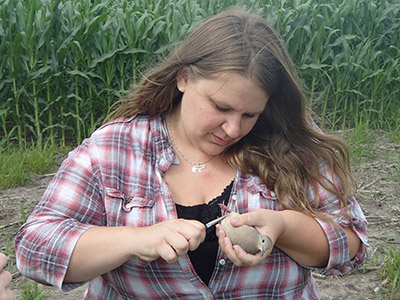
“It was a good foundational learning experience, and I had a really good mentor in John Olson, who is a pillar of the furbearer world,” Albers shared. “I realized that working for a state agency was what I wanted.”
As the state’s trapper education coordinator, Albers worked with instructors to maintain the program, which was among the best in the country, and ensure they had the resources and support they needed. She also learned about managing species, especially with limited harvest opportunities, and developing clear, accurate regulations alongside the state’s biologist, both skills she later applied in Indiana.
“In Indiana, we administered our first regulated bobcat season in 2025, and a lot of the foundational work that I thought of when we were developing it came from what I learned in Wisconsin,” she said.
In 2015, Albers moved to North Carolina to become assistant furbearer and black bear biologist with the North Carolina Wildlife Resources Commission. The position expanded her experience in human-wildlife interactions, particularly communicating with residents about safely living alongside bears. She also worked on conservation concerns involving spotted skunks, whose range had shrunk from the state's central plateau to primarily mountainous areas.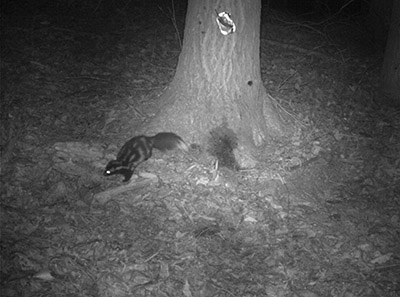
The position also brought Albers another important mentor as a woman in the profession: Colleen Olfenbuttel, the black bear and fur biologist for North Carolina from 2007 to 2024.
In May 2017, the Midwest came calling and Albers joined the Indiana DNR as its furbearer.
“A lot of my sensibilities align really well with the Midwest and I also was interested because states run their furbearer programs differently,” Albers shared. “In Wisconsin, we had a furbearer management team that did more of the management, regulation and trapper education, but there was a separate team that did the research and developed the research projects. In North Carolina, we proposed both. We proposed the research and got the universities involved and also were doing the regulations. I was really interested in Indiana, because I would have the opportunity to do both, develop the research, work with great partners to get that done and also still work on the regulations and outreach to the public. Also, I like bears, but I prefer animals I can easily carry in my arms, so I was happy to get back to just furbearers and small carnivores.”
One of Albers’ significant contributions in Indiana has involved bobcat research and management.
“I have been thinking about bobcats pretty much since the day I got here and Purdue has been really instrumental in that” she said. “We had some bobcat data that we hadn’t had time to do anything with and Purdue was really critical in taking that data and putting it to use. Pat Zollner was really important in developing an agent-based population model as was Rob Swihart and former Purdue postdoc Landon Jones. Then, the last few years, laws passed and rules changed and Indiana implemented its first-ever regulated bobcat season in fall 2025.”
Developing the season required balancing competing public interests, from residents concerned about wildlife conflicts to those who value hunting and trapping as outdoor activities.
“It has been a lot of work because I really believe my division’s mission is to balance the benefits of fish and wildlife,” Albers shared. “We are supposed to be managing for everyone and trying to find that balance where people who feel like they are having conflicts have options, where people who want to participate in harvest as an outdoor activity have options, and also where bobcats are still going to thrive in Indiana.”
Understanding People, Not Just Wildlife
The bobcat project illustrates a frequently overlooked part of wildlife management: people.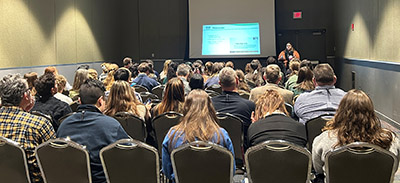
“One of the biggest pieces of advice that I tend to give to students now is that you should understand human psychology if you want to be a biologist,” Albers stated. “I did not get that training as an undergrad or even in graduate school. It was much more about how to understand animals and collect data, but most of my job is understanding humans and how human brains work. Education will only get you so far, because if they have a certain opinion, no amount of education is going to change their minds. In that case, you need marketing, you need other tools. Human psychology is fascinating and a part of that is behavioral economics.”
Albers is working with Purdue researchers on an economics project examining how wildlife management decisions affect people and also the public’s perceptions of deer and furbearers.
“We have some really cool preliminary data that shows that people want to see furbearers when they are recreating,” Albers explained. “They want to go to a state park and see a red fox, but they don’t want any of those animals, except deer, in their backyard. It is a difficult-to-reconcile dynamic of where people want to see them and where they don’t and where they are likely to have conflicts. A lot of that comes down not to the animal’s behavior but to human psychology and how they’re reacting to things.”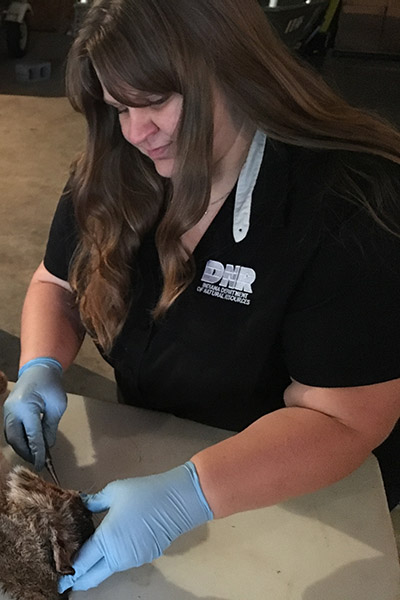
Albers also is interested in applying emerging technologies that can help researchers and managers.
“There has been a lot of movement on the genetics front that is really cool and is really going to help us manage some of these animals moving forward,” she said. “We are doing some projects with Purdue, Ohio University and Mississippi State University, trying to see how we can use emerging genetic techniques to better understand our wildlife.”
One pilot study investigated whether environmental DNA (eDNA) collected from soil could help researchers census weasels and shrews. Another project with FNR’s Andrew DeWoody is looking at river otter diets. Albers also is collaborating with Smith Fellow Dr. Abhinav Tyagi on a project to develop a genetic clock for fish. Researchers will then feed otters the fish of known ages and analyze their scat to determine whether they can still identify the fish’s age genetically. The technique could eventually help reveal whether otters are affecting fish communities in particular areas.
Other researchers at Purdue and Ohio University are using metagenomic techniques to update data on coyote and bobcat diets.
Technology also is helping researchers find the most cost-effective and efficient methods to estimate wildlife populations and inform management decisions.
“We’re actually working with Purdue right now to figure out if there is a better way to get density estimates so we can manage harvests better,” Albers explained. “To see where we have good turkey populations and where we don’t and what habitat factors play into that, we are using both fixed wing planes and drones. It worked for deer, but now we are trying to see if we can scale it down to our slightly smaller animals like wild turkey or coyote. We are trying to identify what data we need to inform rules and regulations for management and harvests and how those align with public values.”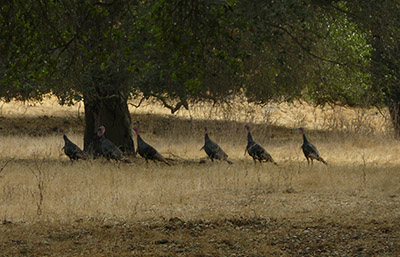
While Albers has learned many things during her career, she knows that the landscape keeps shifting and there is more work to be done.
“Conservation as a field can never be stagnant,” she noted. “There are always new technologies and public values change. We have to find balance in collecting data consistently and finding better options to make sure we don’t get stuck. It can be a really hard line to walk, but an award like this makes me feel like people are acknowledging that I’m hopefully doing something that is positive and a net gain for the state.
“I think we are doing great things and I think that everybody that I work with, both our partners at Purdue and here at the agency, we care a lot about these resources and want to make positive changes and keep us moving forward.”
The Public’s Role in Conservation
Albers emphasizes that effective wildlife management depends on public participation.
“The public is really important because I’m supposed to be managing on their behalf, and we want to know what the public values and have them be engaged in our rule processes, but they also are the core foundation of collecting data that helps us manage these animals effectively.” Albers shared. “We have four different big public volunteer opportunities in my program alone: the summer turkey brood survey; the paddlecraft index in the summer, where paddlers tell us what wildlife they see while they’re on Indiana’s waterways, the archers index in the fall and the skunk iNaturalist project, where we are trying to collect more sightings of our skunks.”
As she reflects back on her career thus far, Albers encourages aspiring wildlife professionals to think broadly about their options and plan for the future.
“First, if you are going into this profession because you don’t want to talk to people, you might have a hard go of it, because that human component is really important no matter what job you go into,” Albers said. “Second, it is hard to do when you are young, but think about what is going to be important to you in 20 years. Do you want to have a family and be able to go to your kids’ soccer games or live near your parents to have a support system? If you want to work in a particular part of the country, you may not be able to work on every species. We don’t have elk or elephants or black bears in Indiana. But, there are so many jobs in this profession that are really critical pieces to the work that we do that aren’t working hands on with wildlife: grant managers, GIS specialists, data analysts, etc. We need people who care and want to do those jobs, not just who want to run out in the woods and chase after a raccoon or whatever.”
Furbearers, Albers’ primary area of expertise, includes animals that are grouped together because their fur has commercial value for being made into garments. These animals, which were historically primarily trapped, include beavers, muskrats, opossums, coyotes, bobcats, foxes, raccoons, minks, otters, badgers, weasels and skunks. Rabbits and squirrels generally are not included as they are usually hunted, not trapped, and their fur has limited commercial value.
Managing these species, along with Indiana’s wild turkeys, keeps Albers plenty busy.
“I’m a project manager with statewide responsibilities for those species,” Albers explains. “I coordinate outreach, surveys and research and work with partners to do all of those different things. I just try to keep the plates spinning in the air for all of the different things that we need to get done, including regulations and educational materials.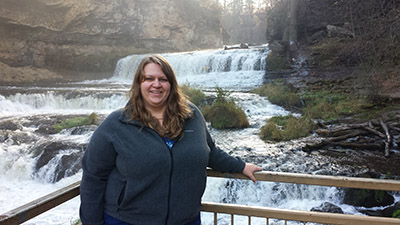
“With the addition of turkeys to my position, I’ve had to learn more about birds, but since they use a lot of the same habitats it has probably been an easier shift than other species would have been. But now I like to joke that I have furbearers and Indiana’s one dinosaur, because turkeys are probably the closest to a dinosaur most of us will ever get.”
Albers career reflects a commitment to collaboration, research and practical conservation. With continued partnerships and an emphasis on balancing wildlife needs with public values, she is helping shape the future of wildlife management in Indiana.
Her selection as the 2025 Chase S. Osborn Early Career Award recipient recognizes not only her contributions to the field, but also to the collaborative work that makes conservation possible.
In 2026, Geriann also took responsibility for wild pheasant and northern bobwhite quail and is now the Furbearer and Gamebird program leader for the Indiana DNR.
Featured Stories
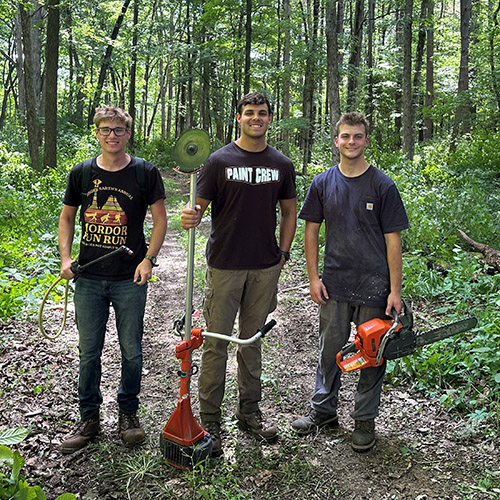
Senior Isaac Johnson, a forestry major with a concentration in forest management, worked as an...
Ashlynn McLaughlin, a senior aquatic sciences major with a concentration in marine and freshwater...
Carolyn Foley, a long-time member of the Purdue Forestry and Natural Resources (FNR) and...
Purdue University’s College of Agriculture recognized nine alumni at the Distinguished...
Keep your eyes peeled across Indiana for the newly minted Purdue Forestry and Natural Resources...
Senior wildlife major Madison Medley spent her summer as a natural resource intern with Hamilton...