

Emma Johnson Named Fenske Award for Wildlife Recipient
Master’s student Emma Johnson received the Janice Lee Fenske Memorial Award for Wildlife at the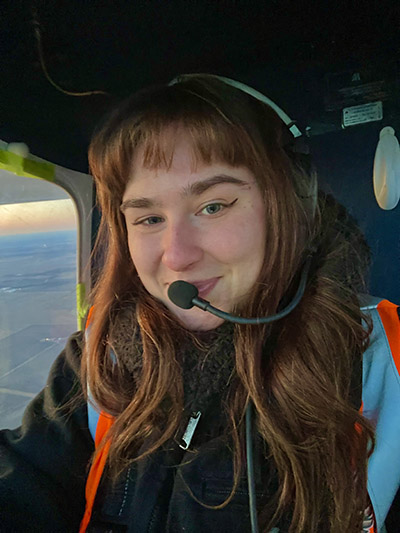 Midwest Fish and Wildlife Conference in Fort Wayne in January.
The Fenske Award was created in 2005 to recognize undergraduate and graduate students for their achievements in the field of fisheries and wildlife management and to encourage participation in the American Fisheries Society, The Wildlife Society and the Midwest Fish and Wildlife Conference. Honorees are selected on the basis of academic ability and scholarly achievements as well as their enthusiasm to protect fisheries and wildlife resources through management activities, selflessness and motivation to teach others, interest in professional involvement, integrity, positive attitude and compassion. The award is named in honor of Jan Fenske, a long-time fisheries biologist for the Michigan Department of Natural Resources, who passed away in 2005 after a long and courageous battle with cancer.
In her application for the award, Johnson shared about her work and her connection to the wildlife and natural resources in the Midwest.
“The Midwest is my home, and I am committed to doing good science that informs wildlife conservation and management in this place that has given me so much. I chose to study Wildlife Science because I have always had an internal conviction to protect wildlife and natural resources. I grew up in Appalachia where wildlife and the outdoors always had a way of protecting me. The deer taught me I could clear obstacles, the trees taught me to listen to my surroundings, and the Canada Geese taught me that I could migrate to a new place. And I did. By the time I was an adult and moved to the Midwest, I knew exactly what I wanted to do. I wanted to protect the wildlife that protected me and the outdoors that had raised me. This is my why. Indiana forests were the first place I learned how to band birds, and the Upper Peninsula of Michigan is where I learned how to set up a trapping grid for squirrels and Peromyscus mice. The Indiana skies are where I learned to capture infrared (IR) imagery of deer, turkey, and coyotes from a fixed-wing plane.”
Johnson, a 2025 wildlife alumna, began her research as an undergraduate student working on an aerial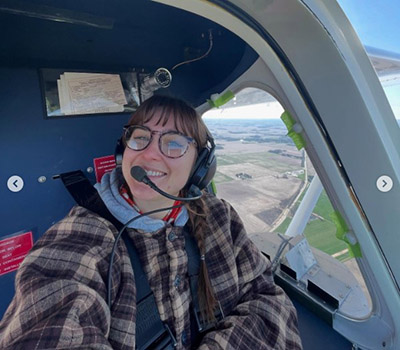 research project for the Indiana Department of Natural Resources in Pat Zollner’s lab. She began by answering a question about how flight speed impacted bias in white-tailed deer estimates from crewed aircraft surveys, involving the operation of an infrared camera on flights in a light-sport aircraft. As a senior, Johnson was selected to lead the first undergraduate-led flight crew of students for the Indiana DNR project. The project involved the collection of data from more than 1,600 aerial transects across Indiana, which would inform deer management in the Midwest, especially in the face of Epizootic Hemorrhagic Disease outbreaks.
As a master’s student, Johnson is continuing that work, leading a flight crew of 15 undergraduate wildlife students, who operate infrared cameras from a Sky Arrow and analyze imagery for the Indiana Wildlife Density Project, as well as seven pilots from Purdue Aviation and Transportation Technology, who fly the team over sampling areas throughout the state. Her thesis is titled “Spatially Modeling White-Tailed Deer Density and Estimating Detection of Turkey Across Indiana Using Crewed Aircraft.” The project aims to create a multi-year spatially explicit deer density model with data collected from the flight crew, while also establishing a long-term aerial monitoring program for the Indiana DNR using sampling transects. She also is evaluating the use of aircrafts with a variety of infrared sensors as a method to estimate coyote and turkey on a state-wide scale, determining the best sensors to detect smaller species like turkey and coyote, as well as analyzing the most cost-effective aerial surveys for deer, coyote and turkey surveys.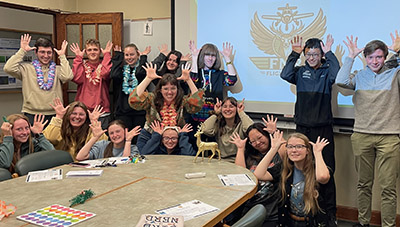
Johnson is acting as mentor on undergraduate Taryn Sneed’s research project titled “Evaluating the Time-Efficiency of Human Observers in the Post-Image Processing of Aerial Imagery.”
At the Midwest Fish and Wildlife Conference, she presented a talk about her research titled “Estimates from the sky: the methods to the madness of crewed aircraft surveys for deer densities.” She also shared about the importance of club involvement in a talk “More Than Membership: How TWS Student Chapters Shape Student Experiences and Connections.” Previously she has presented talks on “Indiana’s white tailed deer populations post Epizootic Hemorrhagic Disease outbreak” at the 2025 Indiana chapter of The Wildlife Society Conference, on “Does Flight Speed Cause Bias in Population Estimates of White-Tailed Deer in Aerial Surveys” at the 2024 Wildlife Society Conference and on “Influence of Aircraft Flight Speed on Bias and Precision of White-Tailed Deer Aerial Surveys” at the 2024 Indiana chapter of The Wildlife Society Conference, which earned the award for best overall flash talk. She also has presented posters at the 2025 Wildlife Society Conference, the 2024 Purdue Forestry and Natural Resources Poster Symposium and the 2024 Midwest Fish and Wildlife Conference.
Since January 2025, Johnson has served as the graduate student representative for the North Central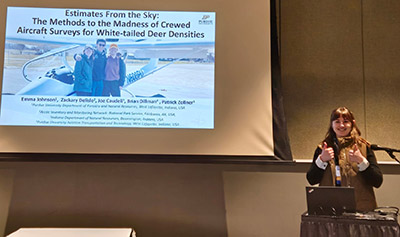 Section of The Wildlife Society, which encompasses Illinois, Indiana, Iowa, Michigan, Minnesota, Missouri, Ohio and Wisconsin. In that role, she works to bring together the 36 student chapters of TWS and introduce them to each other through interactive webinars and social media posts. She also advocated to increase student involvement and representation at the state and section level.
Johnson was named Purdue FNR and the Purdue College of Agriculture’s Outstanding Transfer Student for 2024-25. As an undergraduate student, she was a member of the Purdue Student Chapter of The Wildlife Society and the Purdue Student Chapter of Environmental Education, including a one-year term as each club’s student council representative. She also acted as an undergraduate research assistant and wildlife extension technician with Extension wildlife specialist Jarred Brooke. In those roles, she conducted fecal pellet surveys to estimate deer population density on Purdue properties and measured deer browsing impacts on forests and woodlands using twig aging methods. She also deployed camera traps and tagged species in trail camera photos, conducted point count surveys for game birds, conducted grassland surveys and presented wildlife education materials to youth summer camps.
Johnson also gained valuable experience as a pronghorn field technician on the Oklahoma Pronghorn Project in the summer of 2024 and as an interpretive park ranger and aquatic nuisance species inspector for Colorado Parks and Wildlife at Vega State Park in the summer of 2022.
Dr. Pat Zollner fully endorsed Johnson’s selection for the Fenske Memorial Award.
“Emma has been a very impactful and successful student at multiple levels and in many ways,” Zollner said. “There is no better evidence of her dedication and skill than me keeping her in my lab as a graduate student after her (bachelor’s degree). I can’t imagine anyone better suited for this award than Emma.”
Featured Stories
Carolyn Foley, a long-time member of the Purdue Forestry and Natural Resources (FNR) and...
Purdue University’s College of Agriculture recognized nine alumni at the Distinguished...
Keep your eyes peeled across Indiana for the newly minted Purdue Forestry and Natural Resources...
Senior wildlife major Madison Medley spent her summer as a natural resource intern with Hamilton...
Addy Ellis, a sophomore aquatic sciences and political science double major, spent the summer as...
Zachary Feiner, who earned his PhD from FNR in 2015 and spent two additional years in West...