

Meet Lifetime Achievement Award Winner Ted Cable
"Our ability to perceive quality in nature begins, as in art, with the pretty. It expands through successive stages of the beautiful to values as yet uncaptured by language" – Aldo Leopold.
Dr. Ted Cable, Purdue Forestry and Natural Resources’ 2025 Lifetime Achievement Award recipient, has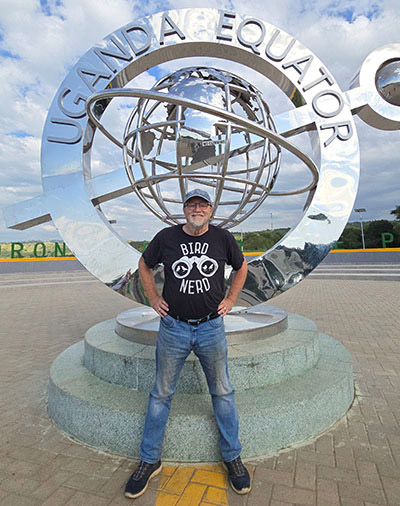 dedicated his career in nature interpretation and teaching and as an author to helping people see beauty in things that are not pretty: from lesser-known species of birds to flawed people, landscapes along seemingly boring stretches of highway to historical landmarks and events. He aims to teach people to discover as Walt Whitman said that “a mouse is miracle enough to stagger sextillions of infidels…” or as Henry Miller stated “The moment one gives close attention to anything, even a blade of grass, it becomes a mysterious, awesome, indescribably magnificent world in itself.”
Cable, who earned his master’s degree in wildlife ecology from Purdue in 1980 and PhD in forest recreation management in 1984, has made his impact on the field of natural resources through his work as an educator, advisor and researcher in the parks and recreation interpretation community throughout the world. The Lansing, Ill., native has written 15 books and published more than 250 articles on topics from nature interpretation to birding to travel, while also acting as a professor and administrator at Kansas State University for nearly 35 years. He has contributed to the design and development of many interpretive trails at local, state and national parks, while also training travel and tour guides across the world in heritage interpretation. He also has served the broader natural resources community as a journal editor, board member, consultant and advisor.
“As interpreters and naturalists, people working at a nature center, state park, national park or wildlife refuge, we have the opportunity to change lives, sometimes by the busload,” Cable noted. “I was speaking in Delaware about the gifts that we give our audiences, and how we can meet people’s needs in audiences and a gentleman came up to me afterwards and shared a story with me. He was leading a group of boys on a hike and there was a misfit kid who was looking down and kind of by himself, the outcast. He had a stop on his little nature hike where they would send kids out in different directions to find certain things and he sent this kid in the direction where he knew there was a cave. When everyone came back, kids said ‘Oh, I found a leaf, or I found a bird's nest, or I found a feather, whatever.’ When he got to the kid in question, he said, ‘what'd you find?’ And the outcast kid said very meekly, ‘I found a cave.’ And the guy said, ‘You found a cave!? Really? Let's go check it out!’ And they all went over to look at it. You don't know what that did for that kid. He may have gone home and told his parents, ‘I discovered a cave.’ He may tell that story the rest of his life. He may tell his kids or his grandkids one day that he discovered a cave. You never know how something simple like that could change a kid's life.
“I hope that maybe through my teaching and speaking that maybe I've inspired someone to change lives in their audiences, the people that come to their refuges or parks or wherever they work. I hope it's like a pebble in a pond where the ripples go out.”
It is safe to safe that the ripples have gone out from Cable across the globe from his work in Africa and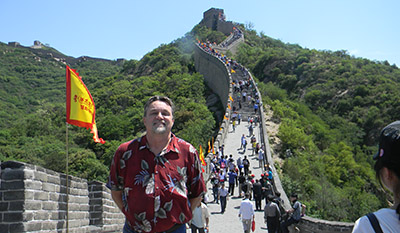 Europe to his impact on students at Kansas State University and countless other individuals who have been impacted by the human connections he has made throughout the years. In 2020, he received the Legend Award from the American Academy of Park and Recreation Administrators. He also has been recognized by the National Association for Interpretation, the Environmental Protection Agency, the Kansas Wildlife Society and the Association of Missouri Interpreters among others for his contributions to interpretation, research and teaching.
“I don’t know what to say about awards; I don’t really feel worthy,” Cable said. “It is always unbelievable to me when people are gracious to honor me in any way. I am incredibly grateful and at a loss for words. As for Purdue FNR’s Lifetime Achievement Award, I was astounded, but thrilled, when I learned I would be receiving it. I never thought I would receive such a prestigious award from such a prominent institution—the university that profoundly shaped me as a person and professional.
“When I arrived at Purdue, I was a mess. I was naïve. I had no idea what it meant to be a graduate student. I was a young kid, newly married, then later a young father. I just knew I loved birds. With a great amount of patience from Dr. (Russ) Mumford and Dr. (Mickey) Weeks, and later Drs. (Doug) Knudson and (Joe) O’Leary, for which I am forever grateful, Purdue, over time, matured me and turned me into a someone presentable professional. I was not a stellar graduate student by any means, so to be recognized by the department that did so much for me is really amazing. That is why this means so much to me now.”
It All Began with Birds
Cable grew up in Lansing, Illinois, a southern suburb of Chicago right on the Indiana-Illinois state line.
“We lived by a golf course and the next street over would have been in Munster, Indiana, but as a small child I spent a lot of time outdoors, fishing with my grandfather, going to Lake Michigan and the (Indiana) Dunes, catching snakes and all of that,” Cable recalled. “I loved birds and had a little bird book as a child, but, in my teenage years, I lost interest in all of that. I went to the University of Illinois-Chicago and was in the pre-med track, majoring in biology and minoring in chemistry. But just toward the end of my undergraduate career, I took an ornithology class to fill out my biology credits and it reignited my passion for birds. Within a short time, I was leading bird walks on Chicago’s lakefront and I think I was the first undergraduate teaching assistant for the ornithology class. I had some very memorable, magical experiences with birds at that time, so, much to my parents’ chagrin, I turned my attention away from medical school and became a nature nut. I began working in nature centers but my passion for birds engulfed me.”
Newly married and working at Sand Ridge Nature Center on the Cook County Forest Preserve with no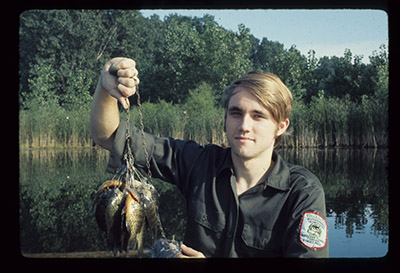 benefits, Cable became a high school teacher to pay the bills, working at Lake Station Edison High School. However, Purdue and graduate school came calling, literally.
“I guess somehow news of my birding activity and passion for birds found its way to Dr. Russ Mumford’s office, who was the bird guy at Purdue, and he invited me to come down and do a master’s degree,” Cable explained. “As a teacher maybe only five years older the high school students I was trying to teach, it was a bit of a challenging situation, so I welcomed the opportunity to go study birds with Dr. Mumford. I will be forever grateful to him. My love of birds is really what brought me to Purdue. I studied wetland birds up at Willow Slough Wildlife Area under his guidance and he led me through to complete that academic experience.”
Cable’s road to completing his master’s research was not an easy one. He set out to study rails at Willow Slough in Newton County, Indiana.
“Rails are very cryptic birds. They are hard to see or find. They slink through the wetlands and are very difficult to study,” Cable shared. “My goal was to trap some and band them and see what happened, if they turned up in hunter’s bags or whatever. That part of the project was an absolute failure. I didn’t trap any rails, but I did find several nests of two species of rails and studied them and found out when they laid their eggs and how long it took them to hatch and how many young they produced. But, while I was looking for rail nests, I found the first nest of a redheaded duck in Indiana and a few other interesting things.
“Then what happened, which was like a miracle from God, is that they refilled the lake there that they had drained the year before and, for some miraculous reason, there just became a total abundance of another bird in the same family called the American coot. They are much more obvious and easier to study. I found 150-some coots’ nests. I had all kinds of data on coots’ nests and nesting and incubation periods. In the process of studying them, I stumbled upon other birds’ nests were of interest. It wasn't really what I had set out to study, so I'm forever grateful for Dr. Mumford and Dr. Weeks, who was on my committee, that they showed me grace and mercy and said, okay, that's good enough. Every time I see a coot even now decades later, I thank God for those coots. They bailed me out and I owe my career to them.”
Cable and his wife, who was a surgical nurse at St. Elizabeth’s Hospital at the time, bought a house in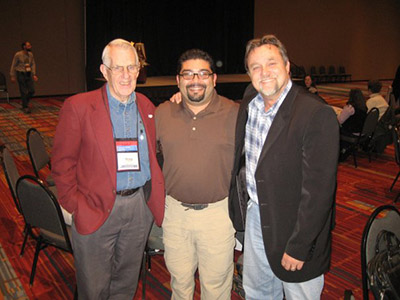 nearby Battleground and soon after adopted a baby. With a newly-minted master’s degree, Cable began working with the Indiana Department of Natural Resources in a minimum wage position. Again, Purdue came calling and Dr. Doug Knudson, who taught interpretation in FNR, invited Cable to work on a PhD. His work as a visiting scientist at Petawawa National Forestry Institute in Ontario, Canada, saw Cable conduct research evaluating the social and economic benefits associated with the Canadian Forestry Service’s public information program. He assessed changes in the public’s environmental attitudes as a result of exposure to the informational messages.
“I really had the conviction that the future of conservation wasn't so much in knowing how to manage deer or pheasants, although that's important, but it was really knowing how to manage and influence people. People are the challenge,” Cable said. “So, I started down a PhD path with Dr. Knudson. However, shortly after taking me on, he left for the Dominican Republic for a project, so Dr. Joe O'Leary, sort of adopted me and held my hand through the process in the absence of Dr. Knudson. Because part of my PhD dissertation was looking at trying to put a price on the value of nature, in dollars and cents, and looking at the economic value of major, I took a lot of economics classes and some social psychology classes, which actually served me very well.
“I’m so fortunate that I came along when I did because Dr. Mumford and Dr. Knudson were generalists. They were naturalists. Dr. Knudson wrote the textbook on outdoor recreation at the time yet he went down to work on a fuelwood study. Dr. Mumford wrote books on mammals and birds, but he also knew plants. I guess I am an old soul academically, very much a generalist.”
His multiple interests and general knowledge about many things made Cable a perfect candidate for an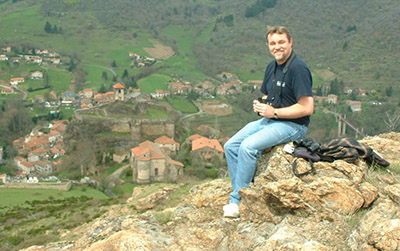 associate professor position in the Department of Forestry at Kansas State University in 1984. There he taught classes ranging from Natural Resource Management to Environmental Interpretation to Management of Water Resources and a Park Management seminar. He later became an ancillary faculty member in ecology and systematics in the Division of Biology. From 1995 to 2019 he served as a professor, assistant department head and interim department head for the newly named Department of Horticulture, Forestry and Recreation Resources.
“My career has been sort of professionally schizophrenic,” Cable explained. “Especially early in my career I went to Society of American Foresters meetings, Wildlife Society meetings, parks and recreation meetings and the interpretation meetings. But, then I decided I needed to focus on one professional arena. Professionally, the interpretation world is where I had the biggest impact, which got me into tourism too, but I never left birds and biology behind. I’ve written four books on birds and six books on interpretation. It was never a complete transition into interpretation.”
Cable never dreamed he would spend nearly 35 years at Kansas State. He had offers over the years to leave, but “the grass just wasn’t greener.” Instead, he stayed and wrote books and travelled to 60 different countries, studying a variety of topics from a McIntyre Stennis-funded fuel wood project to human dimensions wildlife surveys of hunters and fisherman, including the aesthetics and use of windbreaks by hunters, farmers and wildlife. At one time, he also was the editor of the Human Dimensions and Wildlife newsletter.
Like Dr. Knudson had done before him, Cable saw the need for an updated textbook in the field of interpretation, so he wrote it alongside his former mentor.
“I really had no grand aspirations to write a textbook, but it was a matter of need. I was photocopying stuff fo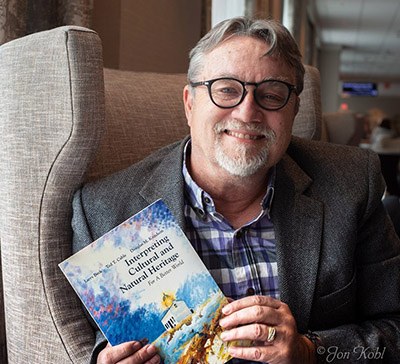 r my classes,” Cable said. “I knew that Knudson had written this very successful outdoor recreation textbook, which was the textbook at the time. He gave me the confidence I could do it or at least I knew that he knew how to write a textbook, so I approached him about writing it together, and he agreed. At the time, it (Interpretation of Cultural and Natural Resources) was really the only comprehensive textbook on the topic. Now, we are in our third edition of it.”
Cable later co-authored a second book on the subject, titled The Gifts of Interpretation: Fifteen Guiding Principles of Interpreting Nature and Culture. Together, those two books gained traction in the field of interpretation and led to speaking engagements and training sessions all over the world. This, in turn, opened for him to speak to tourism industry professionals and train tour guides across the globe due to the similar nature of the field in guiding people and engaging with audiences.
Going International
Cable took his first trip to the Republic of Mali in Africa in 1990 to consult on agroforestry projects in the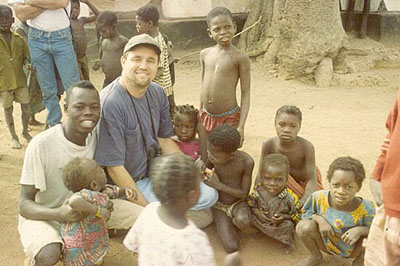 Timbuktu region, while teaching an ecotourism and interpretation course at the University of Bamako as a Fulbright senior specialist. He then moved his family to Cote d’Ivoire in 1993 for a book-writing sabbatical during which he continued working on the textbook with Knudson. Trips to Paraguay, Australia, Mexico, Columbia, Ghana, Botswana, Haiti and Costa Rica followed to finish out the 1990s.
The book “Commitments of the Heart: Odysseys in West African Conservation” about the heroes of conservation in Africa, written by Cable in Ivory Coast in 1993 and published in 2002, features a forward by legendary conservationist Jane Goodall, whom he met and shared his manuscript with at one of her tour events at Kansas State.
“I wanted to highlight people working in conservation in West Africa, the unsung heroes, not the Jane Goodalls and Dian Fosseys of the world that everyone knows about,” Cable said. “People had never heard of some of the folks who were doing great things in West Africa in nondescript countries like Guinea or Sierra Leone, etc.
“My wife has the distinction of being the first white woman born in the city of Timbuktu in Mali. Her parents were in French occupied West Africa as missionaries in the late 1940s/early 1950s, so she has strong links to the area. I wanted to go to West Africa to see the birds. I went there and taught high school at a mission school and wrote my conservation book on evenings and weekends. After I wrote the book, I thought who better to write the forward about unsung heroes than Jane Goodall since she is on the other end of the spectrum. She came through Manhattan (Kansas) on one of her tour events and I went and talked with her, gave her the manuscript and she agreed to write the forward. It was very gracious of her to do that.”
From study abroad trips to national parks and world heritage sites to teaching at world tourism conferences, participating in National Geographic filming and consulting and evaluating ecotourism planning and development projects, Cable’s mission has been to help reveal the beauty of mundane miracles.
“I always tell people if you can’t travel to Africa to see the rhinoceros, see the beauty in the wren in your backyard,” Cable shared. “The perfect examples of that are these interstate highway books I wrote. Everyone said driving through Kansas to Colorado on I-70 is boring. I got tired of hearing that so I wrote a book to see if I could tackle that. I tried to tell stories and reveal that beauty that is there besides the Rocky Mountains, the other miracles and mysteries. Most people don’t see the beauty of the tall grass prairie, the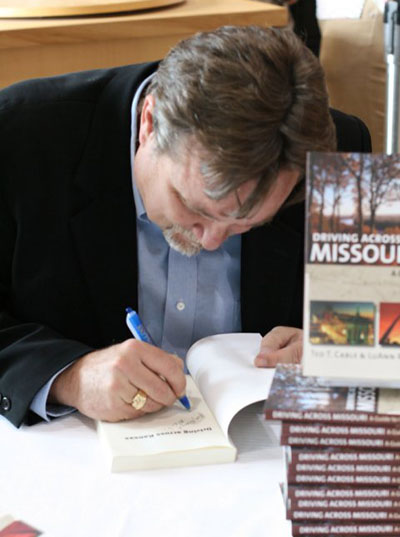 fertile soils, the perseverance of the early settlers, etc. I also wrote one for Missouri where my tagline was to see the beauty beyond the billboard and another about driving across Illinois, which reveals the beauty among the cornfields. I also would sell articles about sparrows, pigeons and starlings, because everybody else wants to write about eagles and bluebirds.”
He has reached an additional audience with his stories that he may never meet through a unique collaboration with Kevin Costner and former president of North Face Bill Werlin, the Autio GPS Audio Tour App. The pair hatched the idea for the app after their wives discussed Bill’s love of travel around Colorado and Kevin’s love of storytelling.
“They started putting together an app and one of my co-authors on the Illinois and Missouri highway books contacted Bill and he decided that they wanted to use some of our content, so that’s how it started.,” Cable shared. “They hired us to write stories for them that weren’t in the books as well. I have done some of the scenic byways in Louisiana, Florida and other parts of the country. They then hire a professional narrator and upload them to the app.”
Cable also has concrete evidence of some of his impact through parks and other installations he has consulted on or helped develop around the world. Two recent projects included a “Become a Birder” trail at Wyandotte County Lake and interpretative signs on campus at Kansas State.
“At Wyandotte County Lake, there is an environmental library where they do nature programming,” Cable explained. “They came up with the idea of having a trial for beginning birdwatchers to help encourage them to notice the birds. We developed signage that shows some of the common birds, but also how to go about looking for birds, what to look for and what to look at. I think it is really nice and I am very proud of it. At Kansas State, in order to become an officially recognized arboretum, they have to have interpretive signs for nearly 100 species of trees. So, I teamed up with the woman who replaced me on the faculty teaching interpretation to design and write those signs. They haven’t been installed yet, but I think they’ll be a real asset to the campus.”
Over the years, through a collaboration with the University of Freiburg in Germany, Cable has welcomed as many as 15 German students at one time into his home and showed them around the United States. He also has taken his own students over to Freiburg to experience life there. Study abroad trips to the Ecuador and the Galapagos, Botswana, Ghana, Cote d’Ivoire, India, and Mexico also provide career highlights.
“I just love the international opportunities to influence students and learn from students and from their perspectives,” Cable noted. “I’ve learned from my own students and I have learned from the French students and German students. The perspectives that they have is such an eye-opener. I also have learned from and am inspired by practitioners in other countries too.”
Beginning in 2002, Cable connected with Blaise Pascal University (now Université Clermont Auvergne) in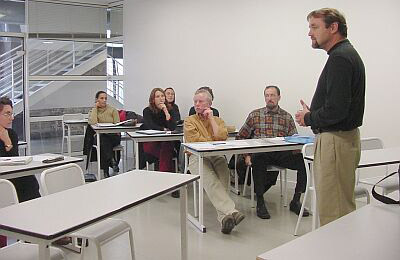 France to give lectures on interpretation, tour guiding and rural tourism. In 2004 and 2006, he served as a visiting professor in the school’s department of tourism. In 2020, he was invited for an informal weekend providing consultation to the American Battle Monuments Commission in Normandy regarding guide training at the American cemeteries there.
“I learned so much from the interpreters there and how they deal with interpreting tragedy and loss and how to draw the line between gratuitous violence and gore,” Cable said. “They have been geniuses as to where to draw the line. You don’t want to sanitize it. It is so complicated and brilliant how they have done that.”
His advice to those considering working in natural resources conservation, whether in wildlife or forestry, interpretation or tourism is to never forget the impact you can have.
“I would remind them that they are entering a very noble and important profession,” he shared. “Sometimes we almost apologize for being in wildlife or forest recreation or parks management. People think we are just hanging around picnic tables or mowing grass or doing something trivial. I would remind them that our country was founded on life, liberty and the pursuit of happiness and we are the pursuit of happiness people. People never say on their deathbed, I wish I had spent more time at the office. They talk about their leisure time. We spend a third of our lives sleeping, a third working and a third of our time at leisure. Our students will deal with the time of people’s lives that really defines their quality of life. It is just as important as anything else you can study on campus.”
In the end, although his work may be about the wildlife, the locations visited or the stories told, for Cable is all about the human connection.
“I am a cheerleader for interpretation,” Cable quipped. “I go out there and try to build up the unsung heroes,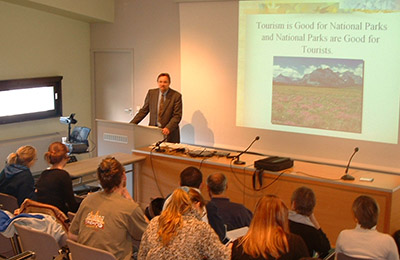 the frontline interpreters and managers, the people who do this day in and day out. They’re doing it because they love it, so I just try to remind them of what they are doing, why they are doing it, how important it is and that it is such a noble profession that they are engaged in. I have the utmost respect and admiration for what they do and they inspire me to no end. Building those relationships with the practitioners and trying to encourage them has been so rewarding for me. To see the stuff that I talk about actually being applied … if I have any sort of legacy in that, that would mean a lot to me.
“It's about making connections between the visitor, the public and the resource, whatever the resource is, whether it's historical, cultural, or natural. It's making those heart connections even more importantly than the head connections. Jacques Cousteau said that people will only protect what they love. My whole thing about seeing the beauty in things that are not pretty goes back to if they see the beauty in it, then they'll come to appreciate it and care about it. If they care about it, they'll care for it. I am kind of the eHarmony of nature. I want to introduce them to nature or history, etc., bring them together and make that connection.”
Featured Stories
Ashlynn McLaughlin, a senior aquatic sciences major with a concentration in marine and freshwater...
Carolyn Foley, a long-time member of the Purdue Forestry and Natural Resources (FNR) and...
Purdue University’s College of Agriculture recognized nine alumni at the Distinguished...
Keep your eyes peeled across Indiana for the newly minted Purdue Forestry and Natural Resources...
Senior wildlife major Madison Medley spent her summer as a natural resource intern with Hamilton...
Addy Ellis, a sophomore aquatic sciences and political science double major, spent the summer as...